
Why LLMs Need a Knowledge Base
In this guide on RAG voice AI, large language models are extraordinarily capable at understanding and generating human language, but they have a fundamental limitation that makes them insufficient on their own for business voice AI: they do not know anything specific about your business. GPT-4 knows what insurance is in general, but it does not know the specific terms of your policies. Claude understands the concept of restaurant reservations, but it cannot check whether your restaurant has a table available at 7 PM on Saturday. Gemini can discuss healthcare scheduling in the abstract, but it has no idea which doctors work at your practice or what their availability looks like this week. For an AI voice agent to be useful in a business context, it needs access to current, specific business information – and this is where Retrieval-Augmented Generation transforms a clever chatbot into a functional business tool.
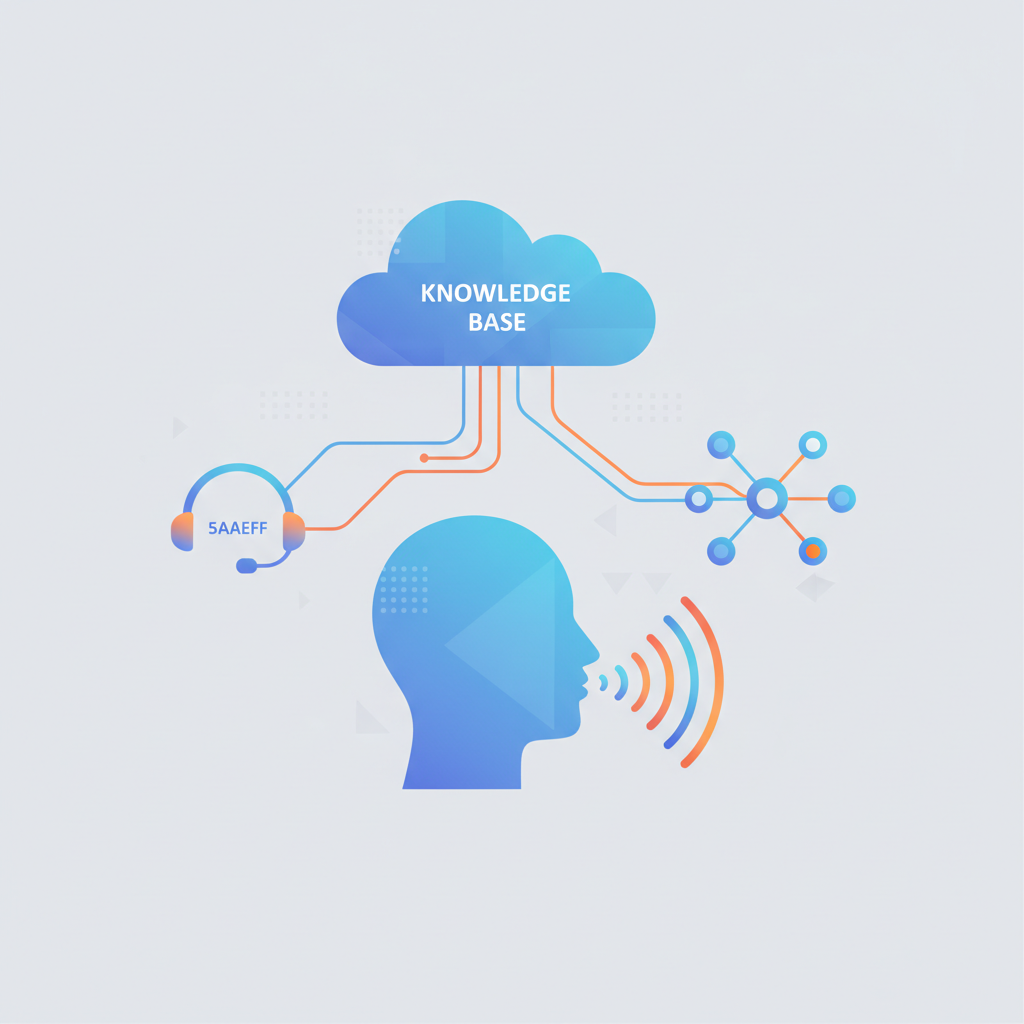
RAG works by adding a retrieval step before the language model generates its response. When a caller asks a question, the system first searches a knowledge base of business-specific information to find content relevant to the question. This retrieved content is then included in the prompt that goes to the LLM, alongside the conversation history and any system instructions. The LLM generates its response based on this augmented context, drawing on the retrieved business information rather than its general training data. The result is a response that combines the LLM’s natural language fluency with the business’s specific, current information – the AI speaks naturally but says things that are accurate for your particular business.
How Vector Search Powers RAG
The retrieval step in RAG relies on a technology called vector search, which deserves explanation because it is fundamentally different from traditional keyword search and understanding the difference illuminates both the power and limitations of RAG-based voice AI. Traditional search matches keywords – if you search for “return policy,” it finds documents containing those exact words. Vector search matches meaning – if you search for “return policy,” it also finds documents about “exchange process,” “refund eligibility,” and “bringing items back” because these concepts are semantically related even though they use different words. This is critical for voice AI because callers express the same question in countless different ways: “can I bring this back,” “what’s your return window,” “I need to exchange something,” and “is this refundable” all ask essentially the same thing, and vector search recognizes this.
Vector search works by converting text into mathematical representations called embeddings – arrays of numbers that capture the meaning of the text in a high-dimensional space. Similar meanings produce similar embeddings, which means finding relevant knowledge base entries is a matter of calculating which entries’ embeddings are closest to the question’s embedding. This calculation happens in milliseconds using specialized data structures (like HNSW graphs) stored in vector databases such as Qdrant, Pinecone, or Weaviate. Kolivri uses Qdrant as its vector store, with an embedding service that processes knowledge base entries from various sources – uploaded files, Google Drive, SharePoint, Salesforce, and other connected systems – and stores their vector representations for rapid retrieval. When a caller asks a question, the system embeds the question, searches Qdrant for the most similar knowledge entries, and passes those entries to the LLM to formulate a response.
Making RAG Work Well in Practice
The theory of RAG is straightforward, but making it work well in a production voice AI deployment requires attention to several practical challenges. The first is chunk size – how you divide your source documents into entries in the knowledge base. If chunks are too large, the retrieved content may contain a lot of irrelevant information alongside the relevant portion, diluting the LLM’s focus and potentially causing it to include incorrect details in its response. If chunks are too small, important context might be split across multiple entries and not retrieved together. The optimal chunk size depends on the nature of your content, but a good starting point is paragraphs or logical sections of 200-500 words each, with some overlap between adjacent chunks to preserve context at the boundaries.
The second challenge is keeping the knowledge base current. RAG is only as good as the information it retrieves, and stale information produces stale responses. If your hours change for a holiday season but the knowledge base still has the regular hours, the AI will confidently give callers the wrong information. If a new product is added to your catalog but not to the knowledge base, the AI will deny its existence when callers ask about it. The solution is to connect the knowledge base directly to your source-of-truth systems rather than maintaining it as a separate, manually-updated repository. Kolivri’s connector system synchronizes knowledge from Google Drive, OneDrive, SharePoint, Salesforce, Monday.com, and SAP, automatically updating the vector store when source documents change. Retell AI offers auto-sync for its knowledge base. The closer the connection between your live business data and the AI’s knowledge base, the more accurate and trustworthy the AI’s responses will be.
The third challenge is handling questions that fall outside the knowledge base. No matter how comprehensive your knowledge base is, callers will occasionally ask questions that it does not cover. The AI’s behavior in these situations is critical – it should acknowledge that it does not have the specific information rather than hallucinating an answer, and it should offer a graceful alternative such as escalating to a human or offering to find out and call back. This “graceful failure” behavior must be explicitly configured, because LLMs are naturally inclined to generate a response for any question, and without explicit instructions to the contrary, they will generate plausible-sounding but potentially incorrect answers when the knowledge base comes up empty. The combination of RAG for known information and disciplined fallback for unknown information produces an AI agent that is both helpful and trustworthy – two qualities that must coexist for voice AI to succeed in a business context.
Related Reading
- מדריך מקיף לשילוב סוכן קולי AI עם מערכת CRM
- Mastering AI Voice Agent CRM Integration: A Comprehensive Guide
- מהפכה בבקרת איכות במוקדים טלפוניים בעזרת בינה מלאכותית

