
Why Pricing Feels So Confusing
In this guide on AI voice agent pricing, if you have spent any time comparing voice AI and CCaaS platforms, you have likely encountered a frustrating reality: every vendor uses a different pricing model, making apples-to-apples comparison nearly impossible. One vendor quotes per seat per month. Another quotes per minute of AI conversation. A third charges per active user hour. A fourth combines a platform fee with usage-based charges that vary by which AI models you select. And nearly all of them require a conversation with a sales representative to get actual numbers for anything beyond the entry-level tier. This complexity is not accidental – it is a consequence of genuinely different business models and also, frankly, a strategy that makes it harder for buyers to comparison shop. Understanding the underlying pricing structures, including the hidden costs that do not appear on the pricing page, is essential for making a decision that your finance team will not regret twelve months later.
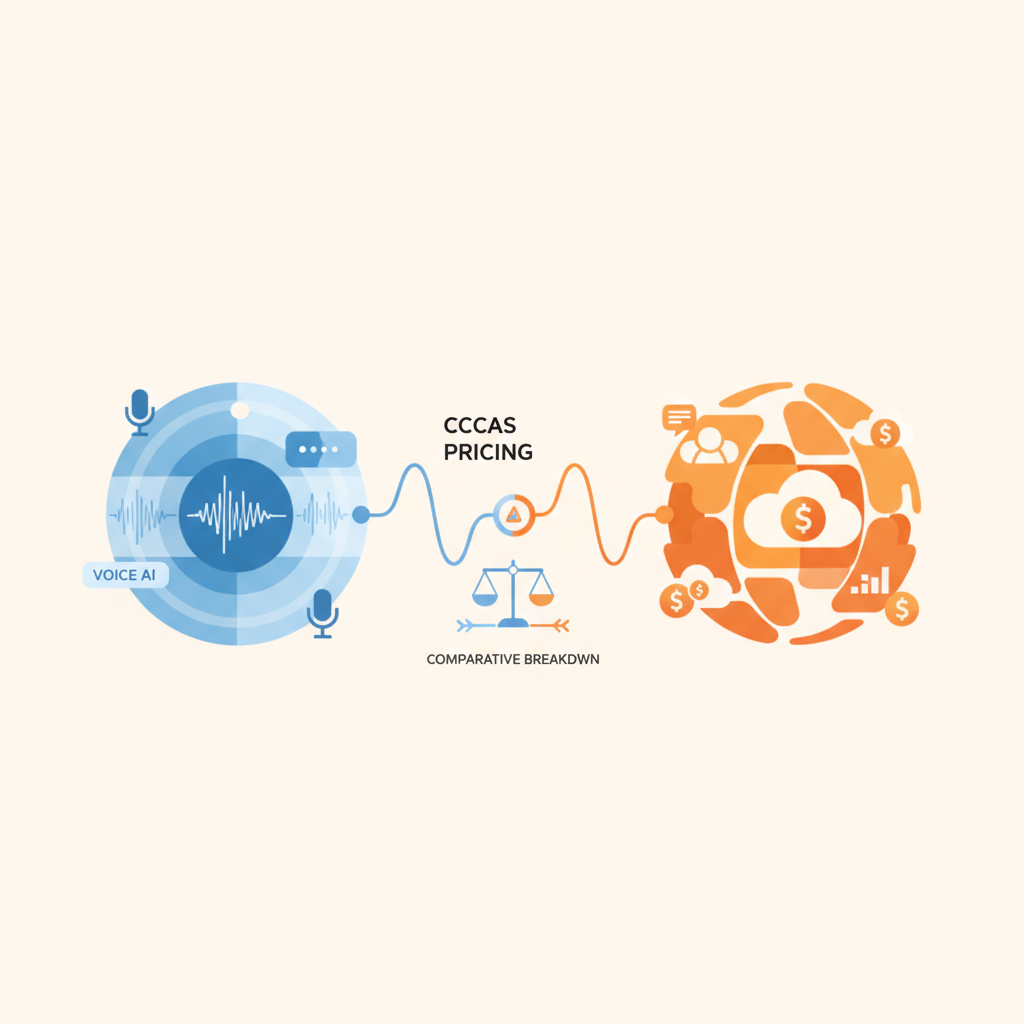
Per-Seat Pricing: The Traditional Model
Per-seat pricing is the oldest and most familiar model in the contact center industry. You pay a fixed monthly fee for each agent who uses the platform, regardless of how many calls that agent handles or how many hours they actually spend on the phone. Five9 starts at $119 per seat per month for its Digital tier and climbs to $159 for Core, with Plus, Pro, and Enterprise tiers priced on request. Talkdesk starts at $85 per seat per month for CX Cloud Essentials, with Elevate and Elite tiers above that. Genesys Cloud CX offers three tiers at $75, $115, and $155 per seat per month. RingCentral’s RingCX product is priced at $65 per agent per month. The per-seat model has the advantage of predictability – you know exactly what you will pay each month based on your team size, which makes budgeting straightforward.
The disadvantage of per-seat pricing becomes apparent when you consider utilization. A contact center seat costs the same whether the agent handles 20 calls per day or 60. During slow periods, you pay the same per-seat fee for agents who may be idle much of the day. During peak periods, you pay the same fee for agents who are overwhelmed and unable to provide good service. There is no financial incentive built into the model to optimize call handling or leverage AI to reduce the number of seats required. And for smaller businesses, the per-seat minimum – many enterprise platforms require 10, 25, or even 50 seat minimums – creates a floor cost that may be far higher than what their actual call volume warrants. A business that needs two people to handle phones but has to buy ten seats to meet the platform minimum is paying five times what their usage justifies.
Per-Minute Pricing: The AI-Native Model
Per-minute pricing emerged with the AI voice agent platforms and reflects the fundamentally different economics of AI-handled calls versus human-handled calls. Instead of paying for agent seats, you pay for the actual minutes of AI conversation. Bland AI charges $0.11-0.14 per minute with platform fees ranging from $0 to $499 per month, and offers off-peak rates as low as $0.03 per minute. Retell AI uses a total per-minute rate of $0.07-0.31 depending on which speech, language, and telephony components you select, with a base rate of $0.055 per minute plus add-ons. Vapi charges approximately $0.05-0.15 per minute depending on the model stack. Amazon Connect uses pure pay-as-you-go pricing at $0.038 per minute for voice, $0.010 per chat message, and $0.014 per SMS – with no minimum commitments or upfront costs whatsoever.
The appeal of per-minute pricing is that costs align perfectly with usage. A business that handles 1,000 minutes of AI calls per month pays only for those 1,000 minutes. During a quiet month, costs drop automatically. During a busy month, costs rise but so does the value being delivered. For many small and mid-size businesses, the per-minute model results in dramatically lower costs than per-seat licensing. Consider a business that receives 50 calls per day averaging four minutes each – roughly 1,000 call minutes per week or 4,000 per month. At $0.12 per minute on an AI platform, that costs $480 per month. The equivalent coverage with human agents would require at least two full-time staff members costing $6,000-8,000 per month in salary alone, plus a per-seat CCaaS license. The per-minute AI model costs less than 10% of the human alternative while providing 24/7 coverage.
Hidden Costs and What to Watch For
Regardless of which pricing model a platform uses, the published price rarely tells the complete story. Implementation and onboarding costs can range from zero for self-service platforms to $50,000 or more for enterprise deployments that require professional services. Telephony charges – the cost of actual phone minutes, phone numbers, and carrier connectivity – are sometimes included in the per-minute rate and sometimes charged separately. AI model costs, particularly for platforms that allow you to choose premium LLMs like GPT-4 or Claude, may be passed through at cost on top of the platform fee. Integration costs for connecting the platform to your CRM, helpdesk, calendar, or other business systems can involve additional fees or require developer time. And overage charges on usage-based plans can create surprising bills if call volume exceeds your plan tier.
The most reliable way to compare costs across platforms is to model your specific scenario: estimate your monthly call volume, average call duration, number of concurrent calls during peak periods, and any specific integration or feature requirements. Then request a detailed quote from each vendor that includes all line items – platform fees, usage charges, telephony, integrations, onboarding, and support. Compare the total monthly cost, not just the headline rate. A platform that charges $0.08 per minute but adds separate telephony, LLM, and STT charges may end up costing more than one that charges $0.15 per minute all-inclusive. The time you invest in this detailed comparison will save you from a year of budget surprises and the painful process of migrating to a different platform because the one you chose turned out to be more expensive than it appeared.
Related Reading
- נפרדים מטלפון-טניס: קביעת תורים חכמה בעזרת בינה מלאכותית
- Say Goodbye to Phone Tag: AI-Powered Appointment Scheduling
- מדריך פשוט לסוכני טלפון AI לעסקים קטנים

