
The Menu Tree Problem
In this guide on AI voice agents vs IVR, everyone has experienced it. You call your bank, your insurance company, or your internet provider, and you are immediately greeted not by a person but by a menu. Press 1 for English. Press 2 for account inquiries. Press 3 for billing. Press 4 for technical support. Press 5 to hear these options again. You press 3 because your issue is sort of related to billing, but not exactly. You end up in another sub-menu. Eventually you reach someone who tells you that you are in the wrong department and transfers you, at which point the hold music starts again and you have to explain your problem from the beginning. The entire process takes twenty minutes for something that should take two. This is the reality of traditional Interactive Voice Response systems, and it is a reality that businesses have accepted as normal for far too long.
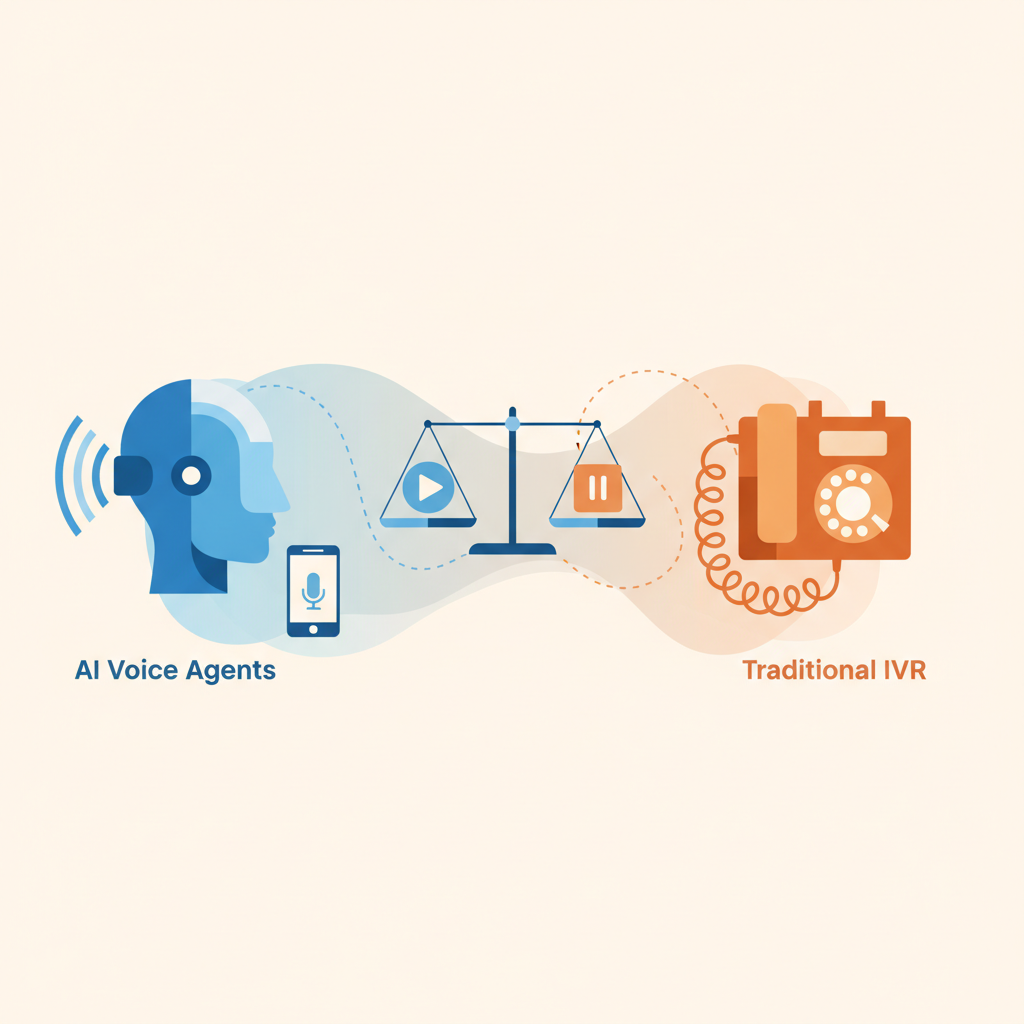
The fundamental flaw in traditional IVR is architectural. These systems were designed around the premise that every possible customer need can be categorized into a finite set of options, and that customers can accurately self-select the right category from a spoken menu. Both premises are flawed. Customer needs are messy, overlapping, and contextual. A caller might need billing help that requires technical knowledge, or a sales inquiry that involves an existing account issue. Traditional IVR forces these nuanced situations into rigid buckets, and the result is misrouted calls, frustrated customers, and agents who spend the first two minutes of every interaction figuring out what the previous menu tree failed to sort.
How AI Voice Agents Handle Conversations Differently
AI voice agents approach phone interactions from the opposite direction. Instead of asking the caller to navigate a structure, they ask one simple question: how can I help you? The caller responds in their own words, using whatever language and phrasing feels natural. The AI processes that response using natural language understanding – the same technology that powers modern chatbots and virtual assistants, but optimized for real-time voice conversation. Within milliseconds, the AI has identified the caller’s intent, and it responds with either a follow-up question to gather more information or a direct answer to the caller’s need.
What makes this so fundamentally different is that the conversation adapts to the caller rather than forcing the caller to adapt to the system. If someone calls and says “I got charged twice on my last bill and I also want to know when my contract ends,” the AI voice agent handles both requests in a single conversation. It does not need the caller to prioritize one issue over the other or navigate to separate departments. It processes the billing dispute, looks up the account to verify the double charge, initiates a refund or flags it for review, and then seamlessly transitions to pulling up the contract details – all in one flowing conversation. A traditional IVR would route this call to billing first, and the contract question would either be forgotten or require a second transfer.
The conversational memory of AI voice agents is another area where the gap with traditional IVR is enormous. Traditional systems are stateless by design – each menu selection is processed independently, and there is no mechanism for the system to remember what happened earlier in the interaction. AI voice agents maintain a complete record of the conversation in working memory. If a caller mentions their name at the beginning of the call, the AI uses it throughout. If the caller corrects a piece of information midway through, the AI updates its understanding and adjusts all subsequent actions accordingly. This creates a conversational experience that feels natural and attentive, the polar opposite of the mechanical, repetitive experience of navigating menu trees.
The Numbers Tell the Story
The performance gap between traditional IVR and AI voice agents is not subtle – it is dramatic, and it shows up clearly in every metric that contact center managers track. Customer satisfaction scores tell the starkest story. Traditional IVR systems consistently generate the lowest satisfaction ratings of any customer service channel, with industry surveys showing that over 60% of customers report frustration with IVR menus, and 83% say they would avoid a company after a poor IVR experience. AI voice agents, by contrast, regularly achieve customer satisfaction scores comparable to or higher than live human agents, because they eliminate the two things customers hate most about phone support: waiting and repeating themselves.
Call containment rates – the percentage of calls resolved without human intervention – show a similarly stark contrast. Traditional IVR systems typically achieve containment rates of 10-25% for anything beyond the most basic inquiries like balance checks or store hours. Most calls eventually require a human agent, meaning the IVR served primarily as a delay mechanism rather than a resolution tool. AI voice agents routinely achieve containment rates of 60-85% depending on the complexity of the use case and the quality of the knowledge base backing them. For highly structured use cases like appointment scheduling or order status inquiries, containment rates above 90% are common. This is not a marginal improvement – it represents a fundamental change in how many calls require human attention.
Average handle time drops significantly as well. Traditional IVR adds an average of 2-4 minutes to every call just for menu navigation, transfers, and re-explanation. AI voice agents eliminate this overhead entirely. The caller states their need, the AI responds, and the interaction progresses linearly toward resolution. For the calls that do require human escalation, the AI passes along a complete summary of the conversation, the customer’s verified identity, and the specific issue – so the human agent can skip the discovery phase and go straight to solving the problem.
Why Businesses Are Switching Now
The migration from traditional IVR to AI voice agents has accelerated sharply over the past two years, driven by three converging factors. First, the technology has reached a maturity threshold where it reliably works. Early voice AI products were impressive in demos but inconsistent in production – they stumbled on accents, lost context in longer conversations, and frequently misunderstood ambiguous requests. The current generation, powered by large language models like GPT-4 and purpose-built voice AI platforms, has largely solved these problems. Second, customer expectations have shifted permanently. People are now accustomed to conversational AI through their daily interactions with Siri, Alexa, and ChatGPT. A menu-driven phone system feels archaic by comparison, and businesses are recognizing that their IVR is actively damaging their brand perception.
Third, and perhaps most compellingly, the economics have flipped. Traditional IVR systems require expensive infrastructure, ongoing professional services for menu tree modifications, and they save relatively little money because most calls still require human agents. AI voice agents, particularly from newer platforms built specifically for this purpose, operate on usage-based pricing that scales with actual call volume. A small business might pay a few hundred dollars per month to handle hundreds of calls that would otherwise require a full-time receptionist. The total cost of ownership is lower than traditional IVR for most businesses, while delivering dramatically better results across every measurable dimension. The question for businesses today is not whether to switch from IVR to AI voice agents, but how quickly they can make the transition before their competitors do.
Related Reading
- מדריך מקיף לשילוב סוכן קולי AI עם מערכת CRM
- Mastering AI Voice Agent CRM Integration: A Comprehensive Guide
- מהפכה בבקרת איכות במוקדים טלפוניים בעזרת בינה מלאכותית

